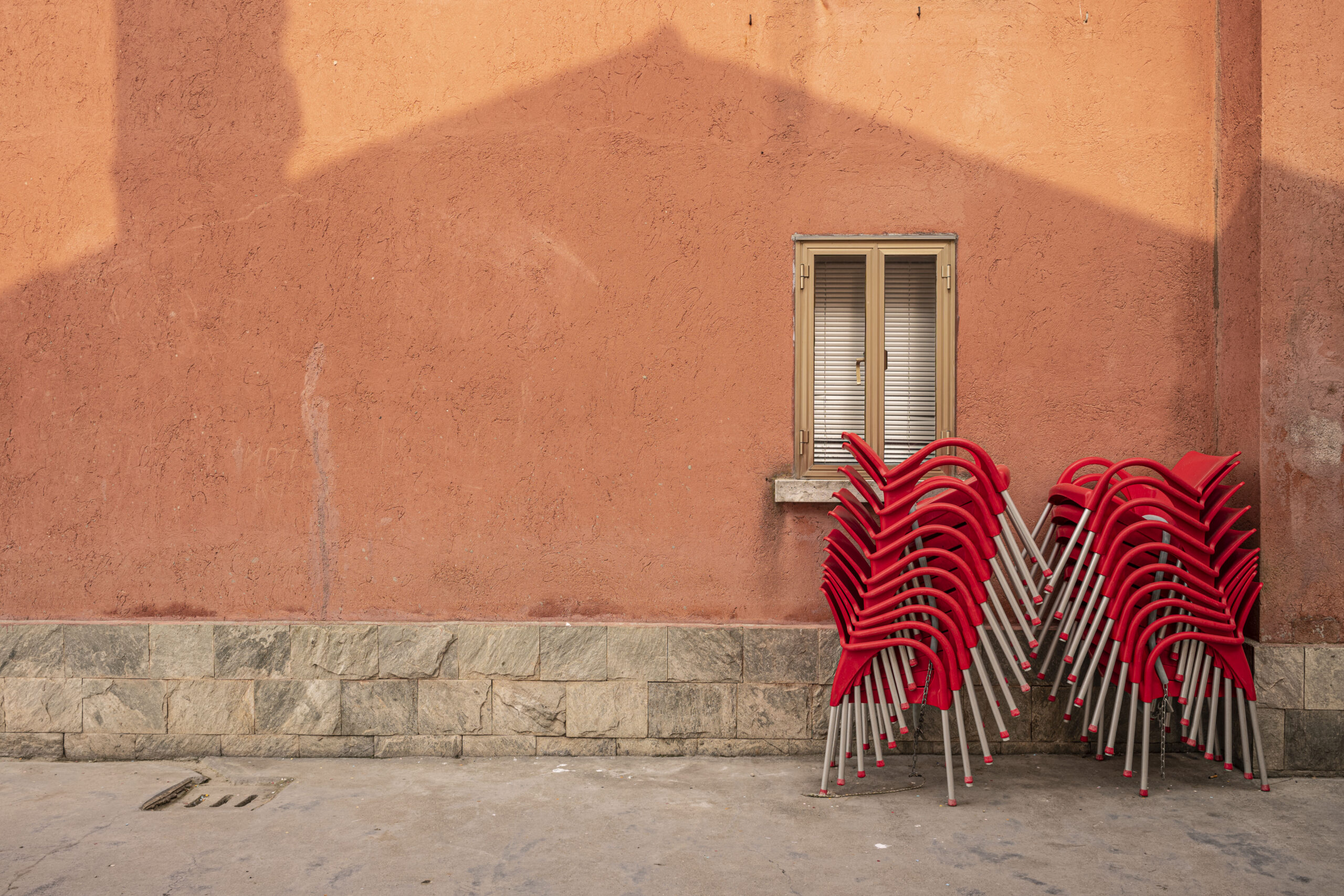
Photo by Anton Giulio Onofri
Pellestrina is the protagonist of the exhibition promoted by the Fondazione Querini Stampalia and Galleria 200C. A strip of land and sand that both connects and separates the lagoon landscape, it becomes, through the photographs of Anton Giulio Onofri, an opportunity to bring different parts of the city into dialogue. Here, the island reveals itself through the light, colours and silence that shape its rhythm, restoring to the landscape its most essential dimension.
The exhibition has been extended through November 6. Admission is free at both venues.
The exhibition Pellestrina isola sottile, curated by Cristiana Collu and Olga Strada, unfolds across two venues: the Fondazione Querini Stampalia, with five images taken by the photographer during the winter season, and Galleria 200C on the Giudecca, where the story continues through photographs taken in summer. Connecting and expanding this visual journey is a text by Giovanni Montanaro, written specially for the exhibition, which accompanies the images and helps convey, through words, the complexity and ever-changing nature of the island.
In winter, Pellestrina, as captured in the photographs at the Fondazione Querini Stampalia, seems to narrow until it becomes a thin strip of land stretching towards the sea. Reaching the island from the Lido means proceeding by subtraction: houses, businesses, roads and human presence gradually become less frequent, the noise subsides and, towards Ca’ Roman, the landscape seems to give space back to vegetation, animals and wind. It is a secluded, almost suspended island, where the sea becomes the point towards which everything seems to reach, and nature feels closer and more solitary.
In summer, through the photographs exhibited at Galleria 200C on the Giudecca, Pellestrina emerges as a small world in motion. The colours of the houses suddenly become more vivid; bell towers, moored boats, voices and everyday gestures come into view. The island opens itself to the slow hum of the afternoons, the scents of the lagoon and a sense of collective life that winter had concealed. Yet even here, behind the cheerfulness and colour, remains the mark of the water that can bring destruction, the presence of the Murazzi sea walls that protect the island, and an awareness of a territory that is constantly exposed and in need of protection.
It is this transition, from the sparse stillness of winter to the vitality of summer, that reveals Pellestrina in its entirety: not two different islands, but two possible states of the same place. Onofri moves through both, allowing the island’s atmospheres and breathing rhythm to reshape the landscape without ever erasing its deepest nature.
The gaze directed towards Pellestrina reactivates a memory that the photographer has already explored. The project is in fact in an ideal dialogue with Roma città chiusa, the work created during the Covid emergency, when Onofri travelled as far as the sea at Ostia to record the surreal suspension of a world suddenly emptied of life.
In Pellestrina, that experience returns in a different form. It is no longer the exceptional condition of the pandemic, but the possibility of finding, within the ordinary life of an island, a time removed from time: a slower, elemental, almost biological rhythm, in which the gaze can finally come to rest and feel part of the landscape. This condition emerges most powerfully in the winter images. When our presence recedes, what usually remains at the margins becomes visible again. Flora and fauna seem to reclaim the spaces we have colonised; for a moment, the landscape appears freed from the scale of human measure.
This apparent harmony carries with it a more unsettling awareness: that of the fragility of the balance between human beings and nature, and of our difficulty in recognising limits.
In this shifting fragment of Venice, photography thus becomes a space for listening. Onofri records what happens when our presence withdraws, allowing a reality that we normally move through without seeing to emerge.
The images are not urgent; instead, they hold a profound tension. They speak of Pellestrina’s vulnerability and, through it, of the vulnerability of the archipelago.
The island becomes a lens through which to look at Venice: a city built upon a fragile balance between land and water, nature and human intervention, permanence and transformation. Onofri’s photographs restore to this landscape a dimension that is both intimate and collective. Each image seems to attune the gaze to a slower frequency, inviting us to be present, to recognise what changes and what remains.
Pellestrina, the Giudecca, where part of this photographic exhibition is presented, and Castello, the sestiere where the Fondazione is located, thus become parts of a single journey: cultural geographies through which to experience new forms of presence, dialogue and participation.
Anton Giulio Onofri was born in Rome in 1959. An author and director for Mediaset, Rai and Sky Classica, he has made films and photographic projects for the Accademia Nazionale di Santa Cecilia, the Galleria Nazionale d’Arte Moderna e Contemporanea in Rome, the Quadriennale di Roma, and other public and private cultural institutions. During the 2020 lockdown, the Galleria Nazionale di Roma commissioned him to create the photographic project Roma città chiusa. In 2021, he produced A casa di Hans, a photographic exploration of the legendary home of composer Hans Werner Henze in the Castelli Romani, before it was cleared following his death. In 2022, he presented PU.Ra at the Musei Civici di Pesaro, a photographic exhibition devoted to the Rationalist architecture of Pesaro and Urbino. The architecture magazine Panteon commissioned him to produce the entire photographic feature for its end-of-year issue dedicated to the Roman locations featured in Pier Paolo Pasolini’s books and films. Also dating from 2022 is Non mi troverai, a series of photographs taken in the Naples home of artist Gian Maria Tosatti, exhibited at the Fondazione Pastificio Cerere in Rome, Mudima in Milan (2023), and Spazio Bianco in Pesaro (2024–25). In 2024, he was among the 40 finalists of the Terna Photography Competition, and his work was exhibited at the Palazzo delle Esposizioni in Rome. On ArtsLife, he regularly contributes a column devoted to cinema, La Bussola di Ago.


